This glossary will help you to get to know the subject, especially in the basic concepts of heat transfer.
closed system
A system of fixed mass is called a closed system and a system that involves mass transfer across its boundaries is called an open system or control volume.
When a stationary closed system involves heat transfer only and no work interactions across its boundary,
Example: A pressure cooker that does not allow gas to escape experiences a change in energy but not in its mass.
es: Sistema cerrado
Conduction
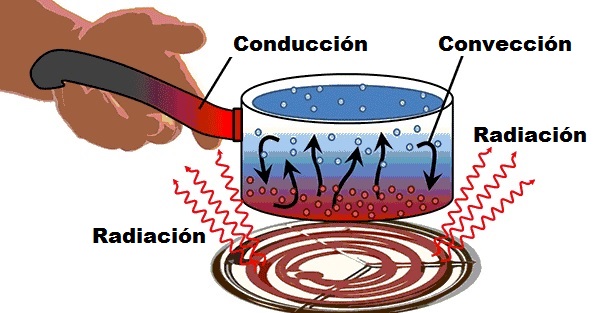
Conduction is the transfer of energy from the more energetic particles of a substance to the adjacent less energetic ones as a result of interactions between the particles, and is expressed by Fourier’s law of heat conduction
Is the transfer of energy from the most energetic particles of a substance to the least energetic
Example: Ice in a bowl of hot water melts through conduction
es: Conducción
consist of
The internal energy represents the molecular energy of a system, and it consists of sensible, latent, chemical, and nuclear forms.
consiste en
Example: The glossary consists of learning english and the basics concepts of heat transfer.
es: consiste en
Convection
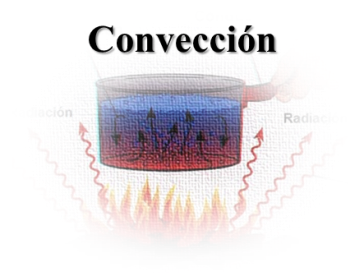
Convection is the mode of heat transfer between a solid surface and the adjacent liquid or gas that is in motion, and involves the combined effects of conduction and fluid motion. The rate of convection heat transfer is expressed by Newton’s law of coolin
is the mode of heat transfer between a solid surface and the adjacent liquid or gas that is in motion, and involves the combined effects of conduction and fluid motion.
Example: When water vapor clouds the glass in a bathroom, due to the hot temperature of the water when bathing.
es: Convección
Deal with
tratar con
Example: you have to deal with english the issue of heat transfer
es: tratar con
Fixed mass
A system of fixed mass is called a closed system and a system that involves mass transfer across its boundaries is called an open system or control volume.
As long as we do not apply forces that can deform or break it, the shape of a solid object remains fixed, that is, they cannot be compressed or expanded.
es: Masa fija
Heat Transfer
The science of thermodynamics deals with the amount of heat transfer as a system undergoes a process from one equilibrium state to another, whereas the science of heat transfer deals with the rate of heat transfer, which is the main quantity of interest i
Heat transfer is the exchange of the sensible and latent forms of internal energy between two mediums as a result of a temperature difference.
Example: When boiling water, the flame conducts the heat to the container and after a time allows the water to heat up.
es: Transferencia de calor
inner surface
superficie interior
Example: Each strip was cut along its length while water was passed over its inner surface.
es: superficie interior
Internal energy
The internal energy represents the molecular energy of a system, and it consists of sensible, latent, chemical, and nuclear forms. The sensible and latent forms of internal energy can be transferred from one medium to another as a result of a temperature
Represents the molecular energy of a system, and it consists of sensible, latent, chemical, and nuclear forms.
Example: In the batteries The body of charged batteries contains usable internal energy, thanks to the chemical reactions between acids and heavy metals inside them. This internal energy will be greater when its electrical charge is complete and less when it has been consumed.
es: Energía interna
mass transfer
A system of fixed mass is called a closed system and a system that involves mass transfer across its boundaries is called an open system or control volume.
Mass transfer is the net movement of mass from one location, which generally means flow, phase, fraction, or component, to another.
Example: an example of mass transfer is the evaporation of water from a pond to the atmosphere
es: Transferencia de masa
open system
A system of fixed mass is called a closed system and a system that involves mass transfer across its boundaries is called an open system or control volume.
An open system is a system that continuously interacts with its environment.
Example: A pot of boiling water. The energy introduced into the system by the fire transforms the water into gas, which is released into the environment.
outer surface
superficie exterior
Example: It appears that the shape of the outer surface is important in determining the transition and the pattern of the secondary flow.
es: superficie exterior
Radiation
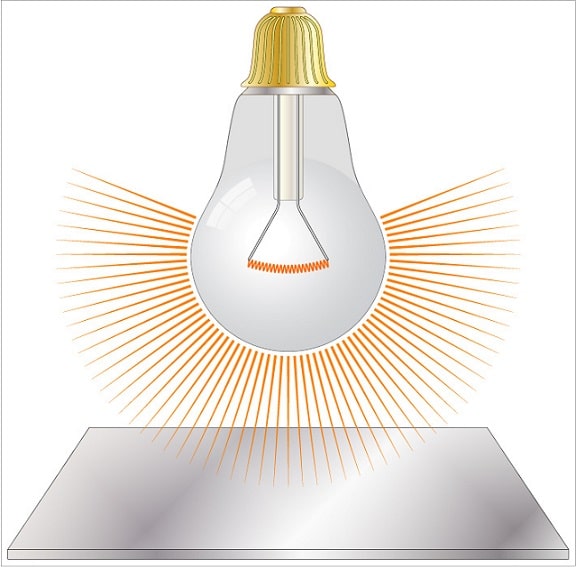
Radiation is the energy emitted by matter in the form of electromagnetic waves (or photons) as a result of the changes in the electronic configurations of the atoms or molecules.
Is the energy emitted by matter in the form of electromagnetic waves (or photons) as a result of the changes in the electronic configurations of the atoms or molecules.
Example: The light emitted by an incandescent lamp.
es: Radiación
Total energy
The sum of all forms of energy of a system is called total energy, and it includes the internal, kinetic, and potential energies.
The total energy of a thermodynamic system can be defined as the sum of each of the types of energies that act in the system.
es: Energía total
undergo
The first law of thermodynamics or the energy balance for any system undergoing any process can be expressed as